.png?width=2017&height=1183&name=TOC%20LOGO%20(2).png)
Is noncompliance silently threatening your operations?
Protect your business, prevent fines, and run flawless, noncompliance-free operations
Is noncompliance silently threatening your operations?
Protect your business, prevent fines, and run flawless, noncompliance-free operations
Take the Pulse of Your Compliance Readiness
Quickly assess where you stand today, identify gaps, and get prepared before the next RRC inspection!

Hi, I’m Fernando González
I’m an authorized Oil & Gas Compliance Consultant, registered with the Railroad Commission of Texas (RRC). I’ve helped operators like you avoid fines, prevent shutdowns, and run flawless, noncompliance-free operations.
My approach is simple: identify risks early, fix issues efficiently, and protect your business from costly interruptions. I combine deep knowledge of RRC regulations with hands-on experience in the field, so you can focus on production while I ensure your compliance is rock solid.
Learn how I can protect your operations →
Why Operators Struggle
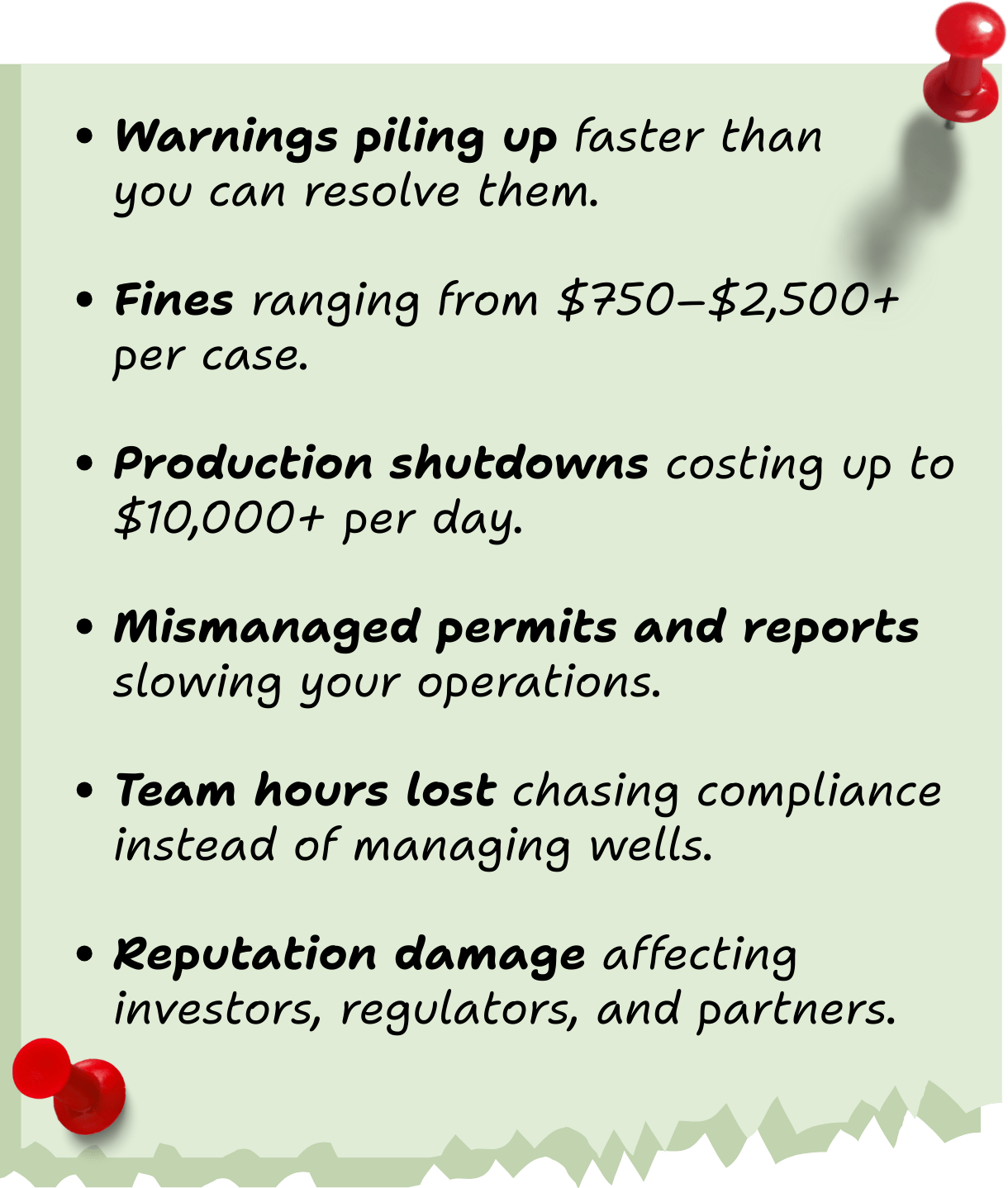
- Warnings piling up faster than you can resolve them.
- Fines ranging from $750–$2,500+ per case.
- Production shutdowns costing up to $10,000+ per day.
- Mismanaged permits and reports slowing your operations.
- Team hours lost chasing compliance instead of managing wells.
- Reputation damage affecting investors, regulators, and partners.
A Clear Process for Regulatory Control
Every operator faces a different regulatory reality. Before recommending services or defining a scope of work, we take the time to understand the situation, evaluate the available information, and determine the right path forward.
Discover
We begin by understanding your operation, current concerns, regulatory context, assets involved, and immediate priorities.
Assess
We review the available regulatory, operational, and supporting information to identify risks, gaps, compliance pressure, and areas requiring attention.
Design
We define the appropriate service level, establish priorities, structure the scope of work, and estimate the professional effort required.
Execute
We carry out the agreed professional work, including analysis, filings, documentation, regulatory coordination, correspondence, and follow-up.
Monitor
We track progress, reassess open matters, and provide ongoing visibility and support as regulatory conditions and priorities evolve.
How this connects to our services: the consulting process helps us determine the appropriate Regulatory Control Service Level and define the actual scope of work. Professional fees are then based on the work required to deliver that scope—not simply on the name of the service level.
The Protection Advantage
We don’t just identify compliance issues — we protect your operations.

RRC regulations made simple.

We implement fixes, not just reports.

Interventions prevent fines, shutdowns, and reputational harm.

You focus on running operations while we shield your business.
Regulatory Control Services for Texas Oil & Gas Operators
Our service model helps operators understand where they stand, identify regulatory pressure early, and move from uncertainty toward preventive compliance or corrective regulatory recovery.
Preliminary Compliance Snapshot
A preliminary review based on available regulatory indicators to help identify whether an operator appears to be in Preventive Compliance, Watchlist, or Damage Control mode. This snapshot creates initial visibility around possible inactive well exposure, P-5 renewal pressure, severance indicators, reporting concerns, or other visible regulatory flags. It does not include a full diagnosis, corrective strategy, filing preparation, or direct RRC correspondence.
Initial Regulatory Assessment
A paid assessment designed to give the operator a clearer understanding of its current regulatory posture. This level includes a deeper review of available records, identification of key areas of concern, preliminary risk prioritization, and a recommended path for next steps.
P-5 Renewal & Inactive Well Compliance Review
A focused review for operators with upcoming or active P-5 renewal concerns, inactive wells, SWR 15 exposure, renewal requirements, or inactive well compliance questions. The purpose is to help the operator understand whether inactive well obligations, documentation gaps, or unresolved compliance items may affect the P-5 renewal process.
Damage Control / Regulatory Recovery Support
Corrective regulatory support for operators already facing active pressure, such as delinquent status, severance exposure, unresolved violations, denied or rejected filings, P-5 renewal issues, enforcement risk, lease-level compliance failures, or operational restrictions. This level is quoted by scope and may include strategic review, prioritization, document support, RRC response coordination, and case-management support.
Routine Filing & Project-Based Support
Support for specific filing cycles, regulatory reports, or targeted compliance projects outside of a monthly retainer. This may include production reports, W-10/G-10 support, H-10 reporting, H-5/H-15 coordination, W-3C/W-3X package support, GAU documentation review, RRC response letters, lease compliance summaries, or other defined project work.
Preventive Compliance Desk / Monitoring Support
Ongoing compliance support for operators seeking to stay ahead of recurring obligations before issues escalate. This level may include compliance calendars, routine filing support, regulatory monitoring, early issue identification, standard RRC correspondence coordination, monthly status summaries, and guidance on when a matter should be escalated to a professional review or Damage Control support.
Not sure where your operation stands?
Request a preliminary review to identify whether your operation is in Preventive Compliance, Watchlist, or Damage Control mode.
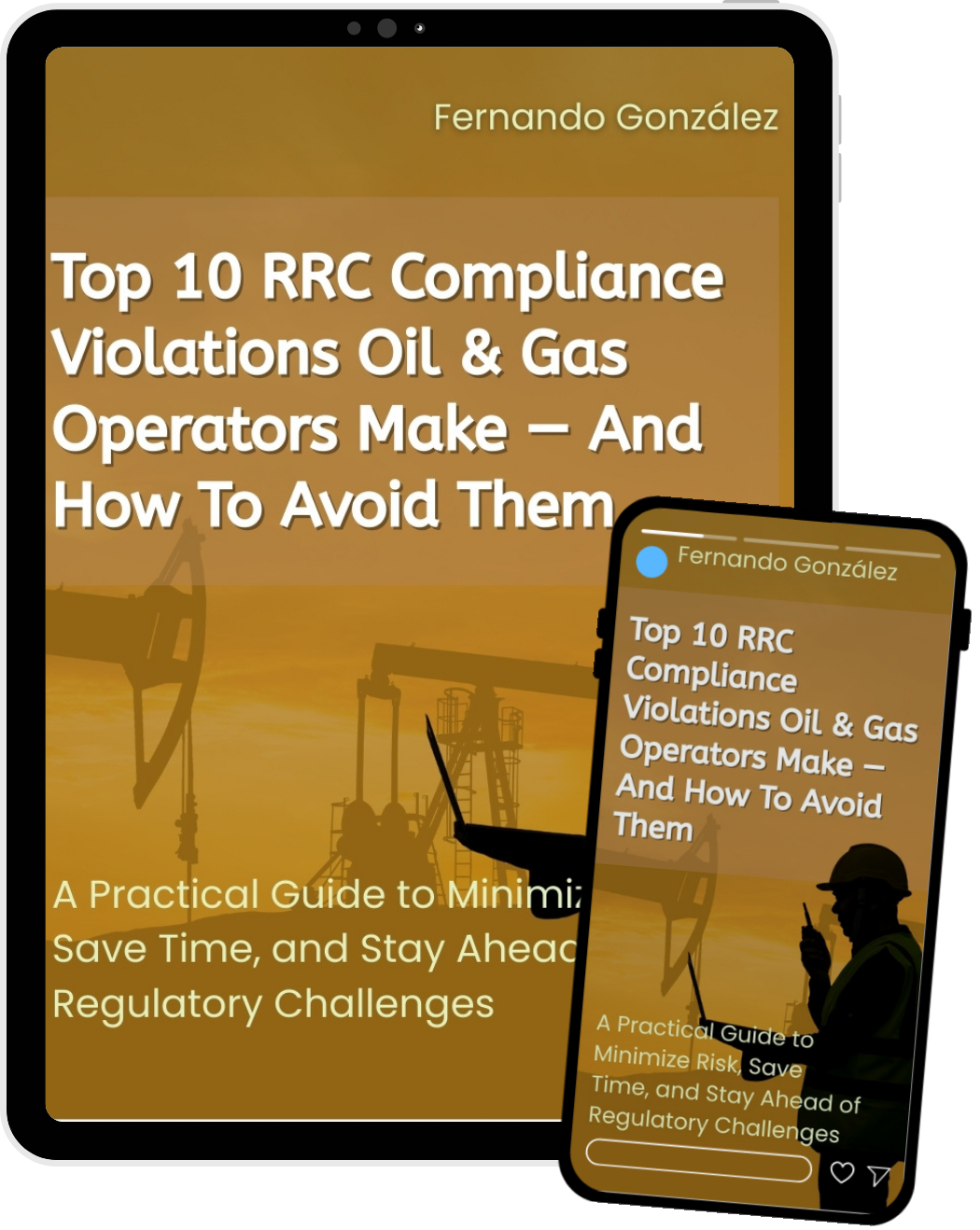
Top 10 RRC Compliance Violations Oil & Gas Operators Make — And How To Avoid Them
A Practical Guide to Minimize Risk, Save Time, and Stay Ahead of Regulatory Challenges
Are you spending more time on paperwork than on production?
In Texas’s competitive oil and gas landscape, even small compliance missteps can lead to costly fines, delays, and operational headaches. This free guide reveals the top 10 violations most operators make—and how you can avoid them with simple, actionable strategies. Whether you're a seasoned producer or just starting out, this e-book will help you streamline your regulatory processes, protect your bottom line, and regain control of your time. Download it now and take the first step toward smarter, safer operations.
.png?width=164&height=164&name=TOC%20SHIELD%20(1).png)
Get Your Personalized Compliance Protection Plan
Every operation is unique. A small field operator in the Eagle Ford doesn’t face the same challenges as a multi-site operation in the Permian Basin. That’s why our protection packages are customized to your specific needs.
To prepare your tailored quotation, please share a few details about your operations. This ensures that the plan you receive addresses your actual risks, keeps you protected, and avoids paying for services you don’t need.
FAQ
Learn More about our services
You’ll find clear answers to the most common questions here. And if you prefer a direct conversation, you can reach out anytime through WhatsApp —no commitment required.
1. How do I know which Regulatory Control Service Level I need?
You do not need to determine the service level yourself.
We begin by understanding your operation, current concerns, regulatory context, and available information. From there, we identify the type of support that best fits your situation and define the appropriate scope of work.
An operator may require one service level or a combination of services depending on the issues involved.
2. What is the difference between the six Service Levels?
The Service Levels describe different types of regulatory support rather than fixed packages.
Level 1 – Preliminary Compliance Snapshot provides initial visibility based on available regulatory indicators.
Level 2 – Initial Regulatory Assessment provides a deeper review and preliminary prioritization of regulatory concerns.
Level 3 – P-5 Renewal & Inactive Well Compliance Review focuses on P-5 renewal requirements, inactive wells, SWR 15 exposure, and related compliance obligations.
Level 4 – Damage Control / Regulatory Recovery Support addresses active regulatory pressure, violations, severances, delinquent status, rejected filings, enforcement exposure, or operational restrictions.
Level 5 – Routine Filing & Project-Based Support covers specific filings, reporting cycles, documentation, and defined regulatory projects.
Level 6 – Preventive Compliance Desk / Monitoring Support provides ongoing support intended to identify and address issues before they become larger compliance problems.
3. Do I have to start with Level 1?
Not necessarily.
Level 1 is useful when an operator wants an initial view of its regulatory condition or when the situation is still unclear.
If there is already a known issue—such as a P-5 renewal problem, severance, inactive-well requirement, filing deficiency, or active violation—we may recommend beginning directly with the service level that addresses that need.
The objective is to avoid unnecessary work and focus professional effort where it creates the most value.
4. What happens before a scope of work is proposed?
We follow a structured consulting process:
Discover → Assess → Design → Execute → Monitor
We first understand the operator's situation, review the relevant information, assess the regulatory need, and then design the appropriate engagement.
This allows us to define the service level, priorities, expected work, and responsibilities before substantial execution begins.
5. Are the Service Levels fixed packages?
No.
The Service Levels provide a framework for organizing different types of regulatory work, but every operator has a different combination of wells, leases, filings, compliance history, and regulatory exposure.
For that reason, the actual scope is developed around the operator's specific needs rather than forcing the engagement into a predefined package
6. Can you help correct the problems you identify?
Yes.
Our work is not limited to identifying compliance concerns. When appropriate, we can assist with corrective actions, regulatory filings, supporting documentation, correspondence, RRC coordination, case follow-up, and other work required to move the matter toward resolution.
The corrective scope depends on the specific regulatory issues identified and the actions required.
7. Can you assist with a specific filing or regulatory project without providing ongoing compliance services?
Yes.
Level 5 – Routine Filing & Project-Based Support is specifically designed for operators that need assistance with a defined filing, reporting cycle, documentation requirement, or regulatory project without entering into an ongoing monitoring arrangement.
Examples may include W-10/G-10, H-10, H-5/H-15, W-3C/W-3X packages, RRC response letters, compliance summaries, or other defined filings and projects.
8. What if my operator is already delinquent, severed, or facing an active violation?
Those situations generally fall within Level 4 – Damage Control / Regulatory Recovery Support.
The first priority is to understand exactly what is creating the regulatory restriction or exposure. We then identify the corrective requirements, establish priorities, and help coordinate the actions needed to move the operator toward compliance.
Because these matters vary considerably in complexity, the scope is established individually.
9. Do you need access to my RRC LoneSTAR account?
Not entirely. As authorized consultants with the RRC, we have access to both public and non-public data provided by the Commission, which is sufficient for the diagnostic phase.
For the resolution phase, there are cases where we may need to activate external-agent access in your RRC LoneStar system. This applies only to specific actions, and we let you know when it is required.
10. How do I get started?
The easiest way to begin is to request an initial review or contact us directly.
We will first discuss the situation and determine what information is needed to understand the regulatory need. From there, we can recommend the appropriate Service Level and define the next step.
You do not need to know which service to request before contacting us.
You can request a diagnostic or contact us directly at +1 (832) 699-0325.
Are expired agreements, incomplete lease files, or unclear ownership records slowing down your next step?
We help Texas oil and gas operators turn scattered public records, lease documents, and ownership references into organized, usable information for lease renewal, extension, landowner outreach, and professional landman review.